#001 — USGC Demand Shift and the 254 kbd Gap
First edition of NextGen's weekly intelligence brief. USGC heavy crude demand is reopening faster than peers can replace it, and Jose Terminal is already showing the congestion signal.
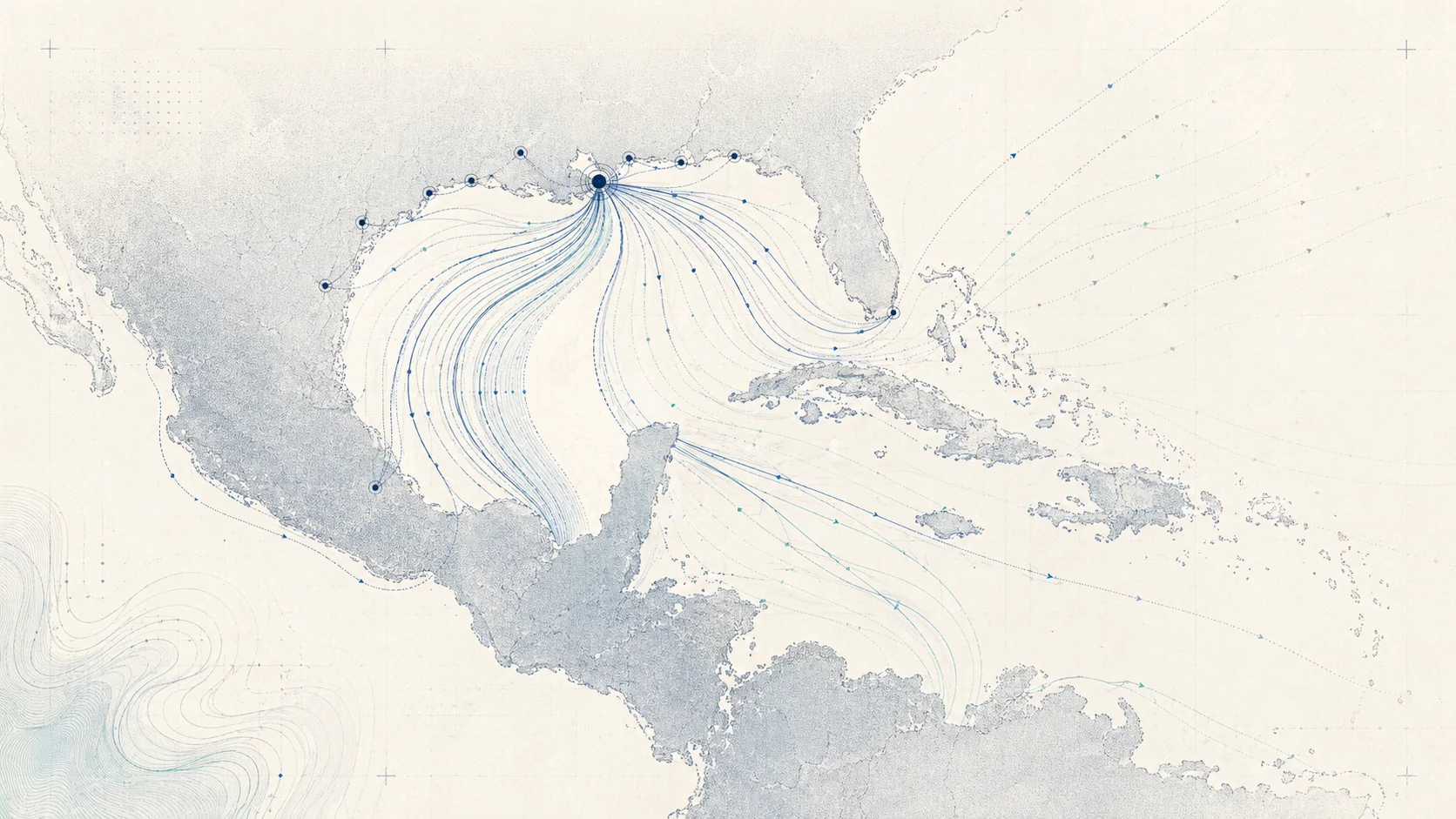
This week's read: USGC heavy crude demand is reopening faster than competing suppliers can replace lost barrels, and Jose Terminal is already showing the kind of congestion you would expect if 's exports keep rising.
For operators, the point is simple: demand is not the constraint. Terminal throughput is.
The Big Picture: USGC Is Running Short of Heavy Crude Suppliers
The US Gulf Coast refining complex — home to approximately 493 kbd of coking capacity across five major facilities — is losing its traditional heavy crude suppliers one by one. The numbers are not subtle:
Total PADD 3 crude imports fell 326 kbd from 2019 to 2024. Mexico and Iraq alone account for 310 kbd of that loss. The supply exiting USGC (~433 kbd) far exceeds supply entering (~179 kbd), leaving an unfilled gap of approximately 254 kbd.
Venezuela has filled 132 kbd of that gap so far — roughly 40% of the Mexico+Iraq decline. No other source is growing at USGC. Every major competitor is flat, declining, or redirecting to Asia.
What matters is simple: Venezuela is not just regaining share. It is filling a supply gap that other heavy-crude exporters are not replacing. If that continues, Jose becomes the operational choke point.
Sources: EIA, OPEC Annual Statistical Bulletin, Pemex, Alberta Energy Regulator. All A1 reliability.
Jose Terminal: Congestion Building
Jose Terminal is already behaving like the constraint in the system.
At 211 kbd to USGC alone, Jose is handling roughly 4 Aframax-equivalent loadings per week to US destinations. If Venezuelan crude fills the 254 kbd gap and total USGC-bound exports approach 400+ kbd, that moves toward 8+ loadings per week — enough to put berth availability under more pressure.
Two Aframax-class arrivals this week from the Caribbean basin reinforce that picture. OSV activity, by contrast, remains flat, suggesting support vessel availability is not keeping pace with the crude loading ramp. Taken together, that looks like a terminal system tightening before the macro demand story has fully played out.
Why Merey Wins: The $10-12/bbl Price Advantage
The economics of USGC coker feed selection are straightforward, and Merey is winning by a wide margin.
Merey's discount of $10–12/bbl versus competing heavy crudes is historically large. At a ~$16.83/bbl discount to WTI, it is the cheapest coker feed available to USGC refineries.
Who is buying? The five USGC refineries with significant coking capacity — and historical Venezuelan purchasing relationships — are the natural buyers:
Best-fit USGC buyers for Venezuelan crude
Ranked by strategic fit; bars show coking capacity, not refinery-level spare capacity
Coking capacity by buyer fit
Capacity is structural coking capacity; it is not assumed spare capacity.
Buyer ranking
Competitor Watch: No One Is Coming to Challenge Venezuela at USGC
The competitive picture is simpler than it looks. The main replacement barrels are not showing up at USGC:
-
Mexico and Iraq account for most of the lost heavy supply, and neither is positioned to rebuild USGC volumes quickly.
-
Canada is producing more crude, but that growth has not translated into meaningfully higher PADD 3 imports.
-
Colombia and Ecuador are not adding enough heavy barrels to close the gap at scale.
The Iran Overlay
- Kharg Island damage: If sustained, removes ~1.5M bbl/d of Iranian crude from global markets. Iran was Venezuela's competitor for Asian heavy crude slots.
- Hormuz disruption: Makes Basrah Heavy and Saudi Arab Heavy physically unavailable — two grades that USGC refineries still take.
- Freight premium: Houthi Red Sea activity adds $3–5/bbl to any Suez-transiting crude. Americas-sourced crude has zero Red Sea exposure.
- Price impact: Brent likely to trade at $80+ range. Merey's absolute price rises, but its discount vs disrupted alternatives may actually widen.
What This Means for Maritime Operations
Every 100 kbd of Venezuelan crude exports to USGC means:
- ~2 Aframax tanker loadings per week at Jose Terminal
- Ship agency, pilotage, and port services for each call
- OSV support for upstream production
- Customs brokering for import/export flows
- Voyage-specific documentation and approvals for each call
At current volumes (211 kbd), that is ~4 Aframax calls per week. At the potential ceiling (~400+ kbd), that is 8+ calls per week.
The constraint is not demand. It is infrastructure — berths, tugs, pilots, shore tankage, and the people needed to keep port operations moving in a market that still runs on paper, WhatsApp messages, and relationships. For a more practical view of what that means at the quay, see our Venezuela Ship Agency Guide.